
Got Mobility?
Like brushing your teeth, mobility training is something that you should be doing everyday. Learn about the benefits of mobility training and how to add it to your workout.

For Best Results, Plan Your Workouts
To borrow from the late efficiency expert, Stephen Covey, “No one ever plans to fail, they simply fail to plan.”

While originally offered as one of the Seven Habits of Highly Effective People, this principle also applies directly to exercise, more specifically, how to design an exercise program. When you go to the gym or start a workout program at home, your last intention is injuring yourself, however, if you don’t properly prepare for hard workouts, that is exactly what could happen. Understanding which of your joints are designed to allow mobility and which are designed to create stability can help you identify the best exercises to reduce your risk of injury.
External Load and Bodyweight
When it comes to designing workout programs there are a number of ways to organize intensity, but one way I like to do is borrowed from my friend Michol Dalcourt and the Institute of Motion and differentiate between bodyweight and external loads. Bodyweight means just that: workouts using your body, this could be strength training or metabolic conditioning (think cardio) for energy system development (improving how your muscles metabolize and use energy). External loads are any form of external resistance from what you can hold to what is attached to a wall or cable machine.
As for as progressing or alternating levels of intensity, throughout the year, my workouts adjust in intensity from bodyweight to strength-endurance, doing 15-20 reps, to strength, 5-8 reps, to explosive power, 4-7 reps, to metabolic conditioning with circuit training. The point is that about every 8 to 10 weeks, I adjust my workouts to change the equipment I use, from barbells to kettlebells, for example; and the level of intensity of the program.
Seasonal Periodization
The idea is that we want to use our bodies differently throughout the year, so we should train differently throughout the year. During the winter, when we’re not doing as much outdoor stuff, we can do more strength training because we can spend more time in the gym. Plus, with the darker winter weather, that’s the better option than exercising outdoors in the dark.
As the season changes to spring and summer, my workouts change to more bodyweight workouts that can be done outdoors on pull-up bars or in a park with a TRX. My fitness goal is to maintain strength and muscle mass as I age; to do that I change my workouts consistently, but ONLY after enough time for a training effect to occur.
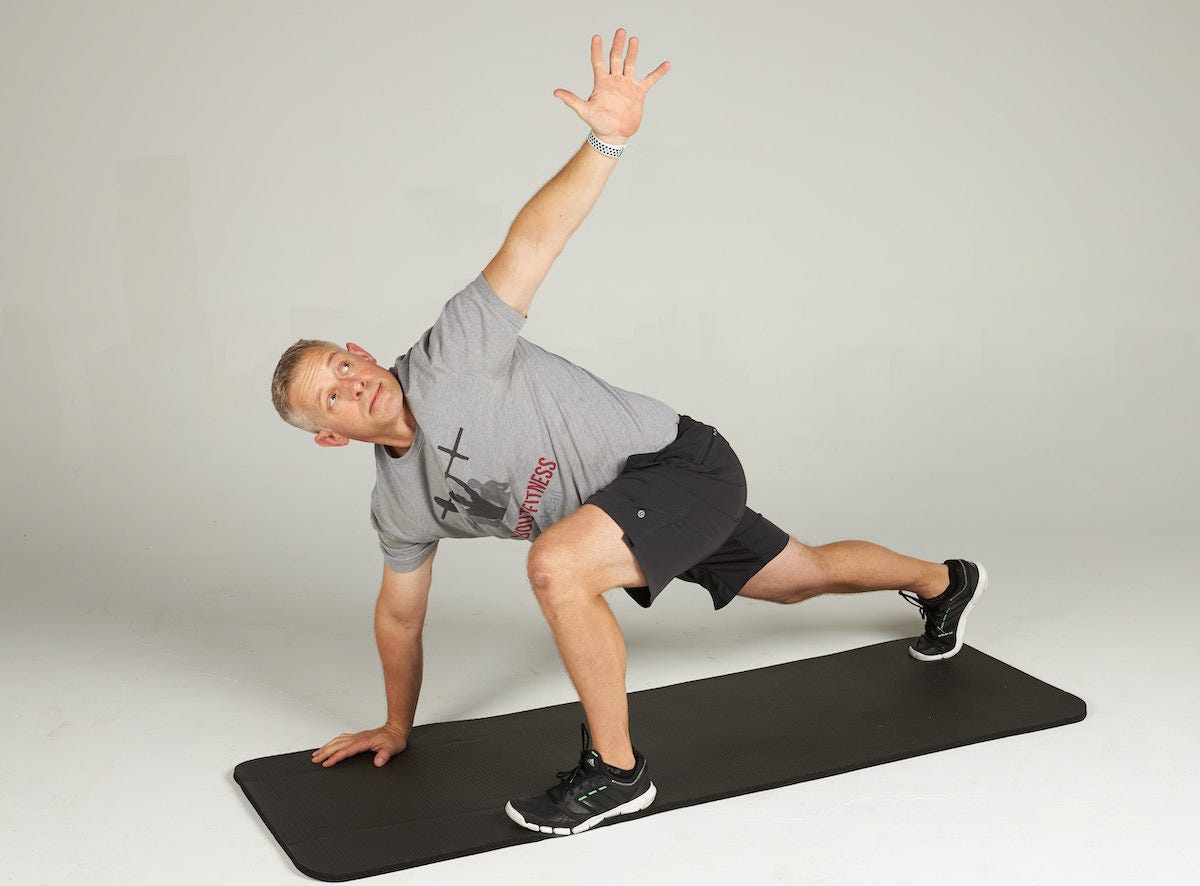
The point is that the point needs to be challenged to work at different levels of intensity throughout the year. The purpose of using high-intensity exercises are to challenge muscles to work harder; however, for optimal results, it is a good idea to alternate hard strength training workouts with lower-intensity mobility or core training workouts.
Mobility Workouts for Active Recovery
This approach to program design is based on the science of periodization, which I described a few years ago. However, no matter what time of year it is, no matter which phase I’m in, my favorite workouts are my core and mobility workouts. These are the workouts I use during active recovery days. They’re also the option on those days when I’m not feeling it for a full strength training workout, but I want to do some movement.
For example, the Phase 2 workout uses unilateral training to develop functional strength is a workout that can be used as a core and mobility workout when performed with just the bodyweight and no external loads.
Simply standing on 1 leg at a time, or using 1 arm at a time challenges the nervous system to control the movement; in fact, there is something called the crossover effect where if you do strength training using only your right leg, your left leg will get a little bit stronger too.
Unilateral, bodyweight exercises are great for mobility and core strength, making them a perfect option for lower-intensity, active recovery workouts the day after a challenging training session. During this phase, the All About Fitness workout for subscribers is focused on functional strength training with unilateral exercises to develop the base strength for outdoor activities in the summer. As strength and coordination improves, the unilateral exercises can be used by themselves for a great core or mobility workout.
The whole purpose of mobility training is to control how the center of mass moves of the base of support.
Mobility, Core or Balance?
In that way, mobility training is exactly the same as dynamic balance training:
When you are moving at a slow, and controlled rate, you are improving tissue lengthen, enhancing joint motion and driving neural feedback all at the same time. The outcome is improved movement control and coordination. Is it balance? Is it core strength? It is mobility?
The answer is: YES, it’s all 3 at the same time!
Because when it comes to performing the basic movement patterns, hinge, squat, lunge, push, pull and rotation, with just our bodyweight is that we need to do to program the computer in our head to control the hardware (muscles and skeleton) that moves us.
Throughout the course of your week, you should plan 1 or 2 low-intensity core/mobility workouts using just bodyweight exercises. You’ll be surprised at how hard you sweat, but you won’t be pushing yourself to a pointless point of exhaustion.
When it comes to using fitness to extend your lifespan, I got YOU!
Learning how to use core and mobility exercises properly is just one example.
After a hard kettlebell or barbell workout, my favorite recovery workout is to use a TRX and a medicine ball. The TRX workout can be found in Smarter Recovery - it’s a standard, standing mobility sequence for the hips and thoracic spine, and it feels AMAZING the day after a hard workout or a long day of sitting in a plane. The benefit of using a TRX for mobility is that you can lengthen the spine, allowing more motion from the hips, the end result is that you move great and feel even greater.
Strength training is the best way to optimize longevity, and should be done 2-3 times per week to a point of fatigue. Mobility training can keep muscles and joints injury-free and should be done the day after a heavy strength workout to ensure an optimal recovery that promotes a full return to homeostasis (Read more about the recovery process in Smarter Recovery).
